

Greetings, AI Thinkers,
The AI revolution has settled the debate: Repetitive, scalable work is quickly becoming the domain of machines. This shift forces a profound strategic question for every individual and organization: What is the defining human role when automation takes the lead? The answer: We must transition from being Doers to becoming Architects.
Inspired by architectural geniuses like Frank Gehry, I’ve broken down the six essential, generic skills that define the human ‘architect’ in the age of AI automation into two separate categories.
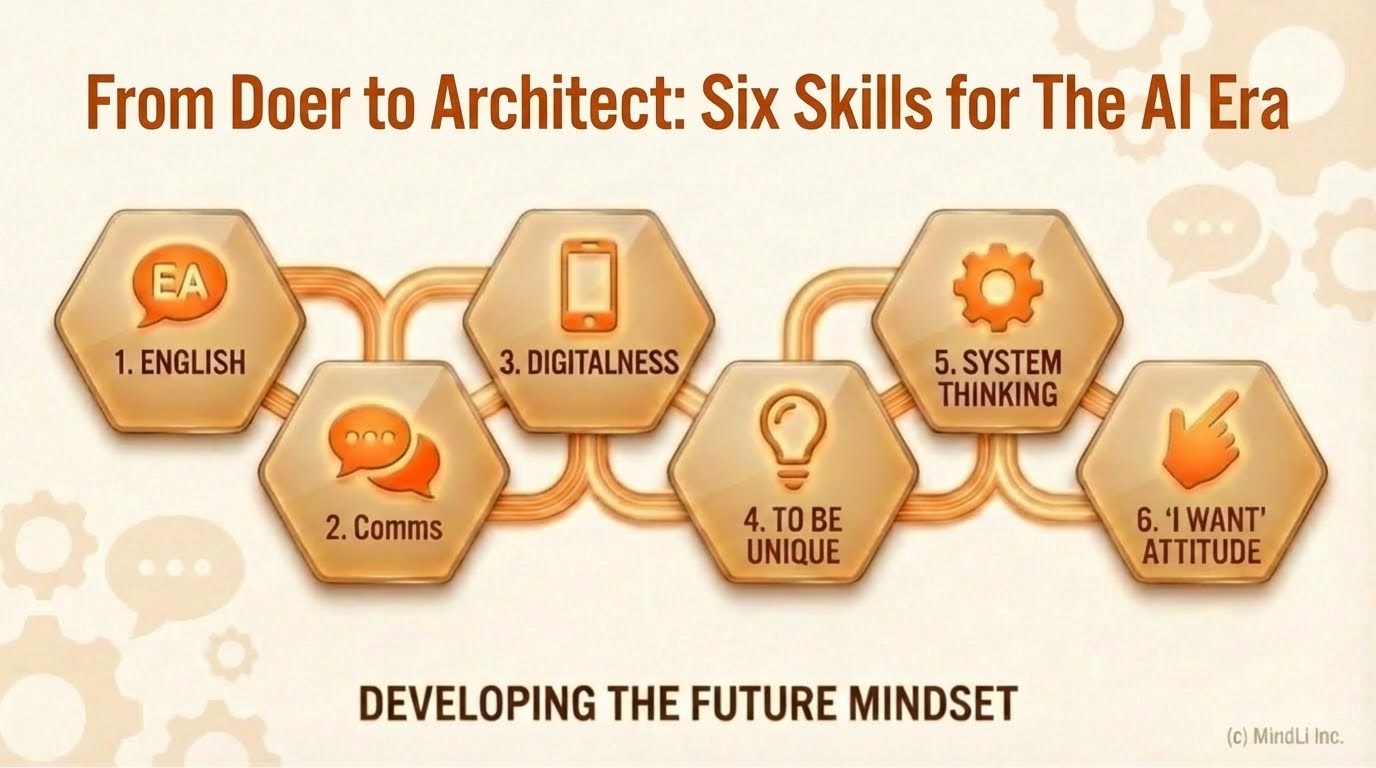
- Three fundamental skills: 1. English, 2. Communication, 3. Digitalness.
- Three leadership skills: 4. System Thinking 5. Uniqueness 6. “I want” attitude.
In my usual style, this is practical, straightforward, and focused on what matters for people who create, lead, and build.
Let’s Think,
Dr. Yesha Sivan and the MindLi Team
P.S. Feedback? Email me.
From Doers to Architects: My six recommended generic skills for the AI age (Source: Yesha On Human Thinking)
A tribute to Frank Gehry {1}. (Visual Note: We are switching to curly brackets, e.g., { }, instead of square brackets for more information, a change made due to some internal AI adjustments.)
The Major Drive: To Be an Architect
I have admired physical and digital architects for years because they combine imagination with structure, turning ideas into reality with both creativity and discipline (I. M. Pei, Zaha Hadid, and Frank Gehry are my heroes). I especially suggest reading about Gehry’s Bilbao Effect {2}.
In the context of future skills for the AI age, I define an architect as someone who connects the past, present, and future.
The future belongs to those who can look at the situation (past), design the transition (present), and consider the desired next (future).
In the age of AI, humans will all become designers of processes, products, services, and outcomes:
- A doctor will not just treat patients; he or she will own a specific disease domain and set the rules for it;
- A banker will develop new products, like new loans and repayment conditions;
- A lawyer will not just write contracts; he or she will create programmable templates for them;
- An engineer will build new machines that can modify themselves, etc., etc.
AI and robots will handle repetitive work; humans will focus on architecture.
Here are my recommended basic skills for architects.
Skills for Me and/or My Organization
In my LinkedIn FOW (Future of Work) group {3}, I am often asked these two questions:
- What are the key skills of the future for me (if you are a student or an early- or mid-career individual)?
- What are the key skills of the future for my company (if you are an HR manager or a senior manager in an organization)
The second question builds on the first question.
In this post, I will share my answer to the first question by proposing six generic skills I consider essential for architects of the future.
As for the second question, employers then have to consider domain-specific skills and backgrounds, such as banking, pharma, and defense, as well as alignment between employees and the company (and this is a call for a future post I will need to write).
Generic skills are the skills you look for in current and future employees. I have developed them for many years, but they are taking on special meaning in the age of AI. To reiterate, these are my choices; I’m happy to hear your feedback.
My Six Recommended Skills
My six skills consist of three fundamental skills for everyone and three leadership skills.
- English — yes. We need to know English. AI actually demands this even more. Expressing yourself in English through prompts, context, and system instructions is essential. Don’t be lulled by AI’s powerful translation abilities — they are helpful for doers, not for architects. Especially at the end of the day, you may need to talk to specific (human or AI) experts to get their advice — they will speak English. Once you’ve covered the basics, it will become a habit to learn more words, nuances, and phrases, better understand people and situations, and communicate effectively (which is point #2).
- Communication—including written, verbal, social, persuasion, impressing, mass communication, and one-on-one communication (test included)—is essential. Usually, it’s better to have 80% content and 20% communication than 90% content and 10% communication. Communication can be learned and is unique to each person.
- Digitalness — the world is digital. And being digital (as in the title of the book Being Digital by Nicholas Negroponte, the founder of the MIT Media Lab {4}) is becoming increasingly critical. With AI, digital is not just the way to do things; it is the core of doing things. Key concepts (such as CSV, common file extensions like .MD, and LDAP) and concepts (DNS, debugging, etc.) will become the key terms for connecting people and processes. Today, there are hundreds of such ideas. I actually should start a dictionary of the most important terms.
- Uniqueness — what makes you special? Did you attend a good school? Did you volunteer at the hospital for five years? Did you win the LEGO competition when you were 18 (I did)? Etc., etc. Being unique means you had opportunities and took them, and that you have the combination of desire and creativity. It usually requires long-term effort.
- System Thinking — seeing the whole, not just the parts. Architects must understand how people, processes, technologies, incentives, risks, and data connect. Systems thinkers map flows, spot bottlenecks, anticipate second‑order effects, and design solutions that actually work in the real world. This skill becomes crucial as AI integrates into every workflow — those who understand how everything fits together will succeed.
- “I want” attitude — the inner drive to move, initiate, and own your path. It is the proactive force of curiosity, ambition, and self-propulsion. “I want” means you seek challenges, ask for responsibility, push for clarity, and create opportunities rather than wait for them. In the AI age, this attitude distinguishes passive users from true architects — those who shape, not follow.
“I want” is the beginning — the desire that initiates action. Grit, as defined by Angela Duckworth, is the stamina that keeps you moving forward. In other words, “I want” starts the journey; grit carries it through. When AI takes on repetitive tasks, this combination becomes what sets humans apart {5}.
What is Next?
If you are an individual (a student or an early-to mid-career professional), take ownership of developing these skills. Seek opportunities to accomplish more and more of these skills. English, Communication, and Digitalness are easier to follow as they are more cognitive. To Be Unique, Systems thinking, and an “I want” attitude are harder as they are more emotional.
If you are an employer, it is time to redefine your people/talent strategy for the AI age (and, again, my recommended skills are just the start), make it clear to your current employees, and actively seek senior, mid-career, and junior (and aspiring) architects.
More info
{1} About the late Frank Gehry, who died on Dec 5th, 2025, at the age of 96: https://en.wikipedia.org/wiki/Frank_Gehry
{2} The term “Bilbao effect” emerged in urban planning to describe the transformative impact of Gehry’s architecture. His design for the Guggenheim Museum in Bilbao revitalized the city, serving as a prime example of how architecture can drive economic and cultural renewal. The museum’s dramatic curves and shimmering titanium panels are defining features of Gehry’s style, emphasizing movement and fluidity. – https://en.wikipedia.org/wiki/Starchitect#The_Bilbao_effect
{3} My future of Work LinkedIn group (ask to join) if you are not there yet. https://www.linkedin.com/groups/10042121/
{4} On Being Digital, the book: https://en.wikipedia.org/wiki/Being_Digital
{5} on Grit – https://en.wikipedia.org/wiki/Grit_(personality_trait)
About MindLi CONNECT Newsletter
Aimed at AI Thinkers, the MindLi CONNECT newsletter is your source for news and inspiration.
Enjoy!

MindLi – The Links You Need
General:
- Website — MindLi.com — All the details you want and need.
- LinkedIn — MindLi 🌍 GLOBAL Group — Once a week or so, main formal updates. ⬅️ Start here for regular updates.
- WhatsApp — MindLi Updates — If you need it, the same global updates will be sent to your phone for easier consumption. This is similar to the above Global group — once a week or so.
- Contact us – We’re here to answer questions, receive comments, ideas, and feedback.
Focused:
- LinkedIn — MindLi 🧠 AI Group — More technical updates on AI, AGI, and Human thinking. ⬅️ Your AI ANTI-FOMO remedy — Almost Daily.
- LinkedIn — MindLi 👩⚕️HEALTHCARE Group — Specifically for our favorite domain — healthcare, digital healthcare, and AI for healthcare — Weekly.
- LinkedIn — MindLi 🛠️ FOW – Future of Work Group — thinking about current and future work? This is the place for you — Weekly.
- LinkedIn — MindLi 🕶️ JVWR – Virtual Worlds Group — About virtual worlds, 3D3C, JVWR (Journal of Virtual World Research), and the good old Metaverse — Monthly.
- LinkedIn — MindLi Ⓜ️ Tribe Group — Our internal group for beta testers of MindLi, by invite — when we have updates, call for advice, need for testing, etc (also ask about our special WhatsApp group).