

Greetings, AI Thinkers,
Over the last few months, I’ve been asked one question again and again: Where are OpenAI and Google actually heading? Not the hype. Not the noise. The real trajectory — economic, technical, and strategic.
Here’s my take:
- A grounded view using the AI Circular Economy as the lens.
- How the big-firm analysis (Goldman Sachs, etc.) translates into real-world implications.
- Insights from the perspective of a daily builder and heavy user of both ecosystems.
This is not a prediction. It’s a forecast — practical, sober, and focused on what matters for people who create, lead, and build in the age of AI.
Let’s Think,
Dr. Yesha Sivan and the MindLi Team
P.S. Feedback? Email me.
My Forecast on OpenAI and Google Based on the AI Circular Economy à la Goldman Sachs (Source: Yesha On Human Thinking)
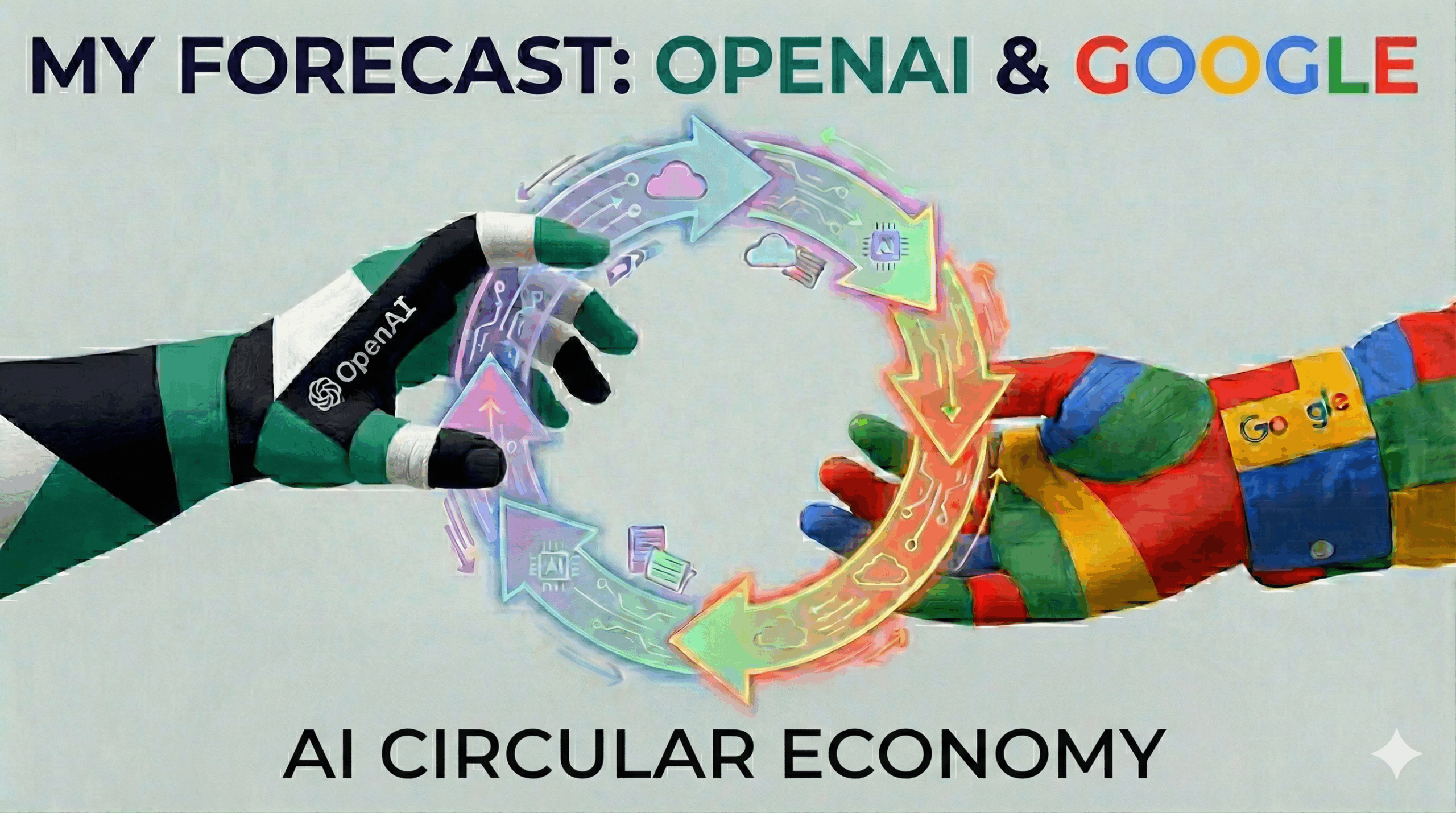
Inspired by a post by James Eagle, my go-to man for anything data/visual thinking. [2]
AI Bubble?
A recent report (Oct 28, 2025) by The Goldman Sachs Group, Inc. (edited by Allison Nathan) highlights the “concern” and “questions” about the ‘AI’ Bubble. Let me tell you what Goldman cannot — it is a mega-bubble. Why? Because of the visible, blatant circular economy. [1]
As James Eagle explains: [2]
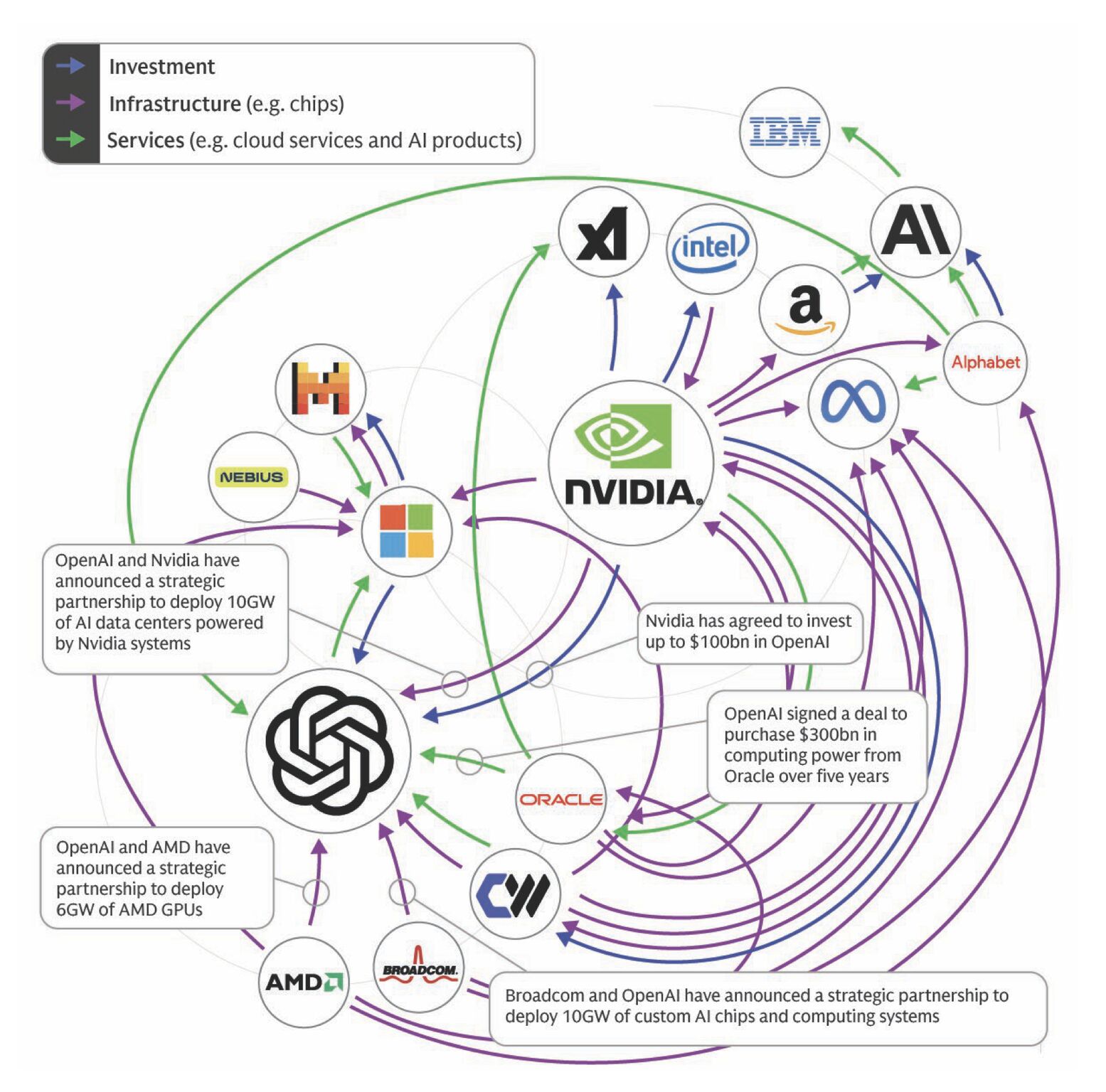
AI is starting to look like a closed loop of money.
Goldman Sachs Research has drawn the picture here really well (see Visual 2). Their network map of AI partnerships is basically a wiring diagram for circular finance.
On top of that, a lot of this hardware depreciates over 6 to 8 years, even though the tech cycle runs closer to 2 or 3 years. Michael Burry has been shouting about this for months. The same names appear on almost every line. Chips, cloud, equity, services. All bouncing around a tiny club that is amplified by the dollar and America’s ability to pull in global capital.
This is not about fraud. It is about concentration and fragility. If the forecasts are wrong and AI infrastructure is overbuilt, whose revenue survives once the circular money slows down? And whose story quietly falls apart?
So What? Focus on OpenAI and Google
I primarily use OpenAI and Google, both as a user and as a heavy API user in MindLi. The health of these companies is vital to me.
I have been closely following both (and some other players) for the past three years. OpenAI continues to innovate, introduce new services, and provide greater value. I’m also less worried about the Chinese competitors. Very few Western companies will use Chinese players, and the fact that they can offer lower costs shows that lower costs are achievable. They face one major challenge.
Google started very low. Their first AI services were relatively inferior. But over the last year (and especially now with Gemini 3), the quality has improved significantly. Systemically, Google offers strong services across the entire stack: from the user (consider how many Gmail users they have) to the enterprise (workplace), to the servers, and down to the chip itself (TPU) [3].
To be honest, Google can lower prices using its own infrastructure, while OpenAI has to pay for its own.
So, Is There a Risk for OpenAI? Yes and No
Yes, we need to worry because the long-term economics don’t add up in terms of the investments, revenues, and capacity to serve, not to mention the viability of electricity to power the data centers (see, for example, HSBC report [4]).
On the other hand, no, OpenAI will be fine because it has already shown its ability to innovate at scale and turn technology into business value. OpenAI is maybe the Google of the AI era 🙂
Even in the worst-case scenario, OpenAI will be acquired by another company. Investors will lose, but users won’t notice the difference.
So is there a bubble in AI? Yes, yes, yes.
Should we be concerned as investors? Yes, yes, and yes.
Should we, as users, be worried? No. In fact, in most cases, irrational bubbles often lead to investments that turn into valuable, innovative technologies. [5]
More Info
- [1] Goldman Sachs report on the AI Bubble: https://www.goldmansachs.com/insights/top-of-mind/ai-in-a-bubble
- [2] James Eagle’s LinkedIn post on the Circular economy: https://www.linkedin.com/posts/jameseagle_ai-is-starting-to-look-like-a-closed-loop-activity-7396812031653326848-v1ho
- [3] See Google AI stack and samples: https://cloud.google.com/blog/topics/startups/differentiated-ai-tech-stack-drives-startup-innovation-google-builders-forum
- [4] See this report on a brutal discussion on OpenAI (by HSBC): https://www.theregister.com/2025/11/26/openai_funding_gap_hsbc/
- [5] Read about railway mania: https://awealthofcommonsense.com/2025/11/the-railway-bubble-vs-the-ai-bubble/
About MindLi CONNECT Newsletter
Aimed at AI Thinkers, the MindLi CONNECT newsletter is your source for news and inspiration.
Enjoy!

MindLi – The Links You Need
General:
- Website — MindLi.com — All the details you want and need.
- LinkedIn — MindLi 🌍 GLOBAL Group — Once a week or so, main formal updates. ⬅️ Start here for regular updates.
- WhatsApp — MindLi Updates — If you need it, the same global updates will be sent to your phone for easier consumption. This is similar to the above Global group — once a week or so.
- Contact us – We’re here to answer questions, receive comments, ideas, and feedback.
Focused:
- LinkedIn — MindLi 🧠 AI Group — More technical updates on AI, AGI, and Human thinking. ⬅️ Your AI ANTI-FOMO remedy — Almost Daily.
- LinkedIn — MindLi 👩⚕️HEALTHCARE Group — Specifically for our favorite domain — healthcare, digital healthcare, and AI for healthcare — Weekly.
- LinkedIn — MindLi 🛠️ FOW – Future of Work Group — thinking about current and future work? This is the place for you — Weekly.
- LinkedIn — MindLi 🕶️ JVWR – Virtual Worlds Group — About virtual worlds, 3D3C, JVWR (Journal of Virtual World Research), and the good old Metaverse — Monthly.
- LinkedIn — MindLi Ⓜ️ Tribe Group — Our internal group for beta testers of MindLi, by invite — when we have updates, call for advice, need for testing, etc (also ask about our special WhatsApp group).