
McKinsey’s article provides an overview of some of the breakthrough developments that quantum computing technology may enable, including an attempt to quantify the impact of leveraging this innovative technology in the coming years.
Quantum computing may provide a solution to problems that have so far been unsolvable and have implications on the overall economy with a huge impact on reducing carbon emissions and removing carbon.
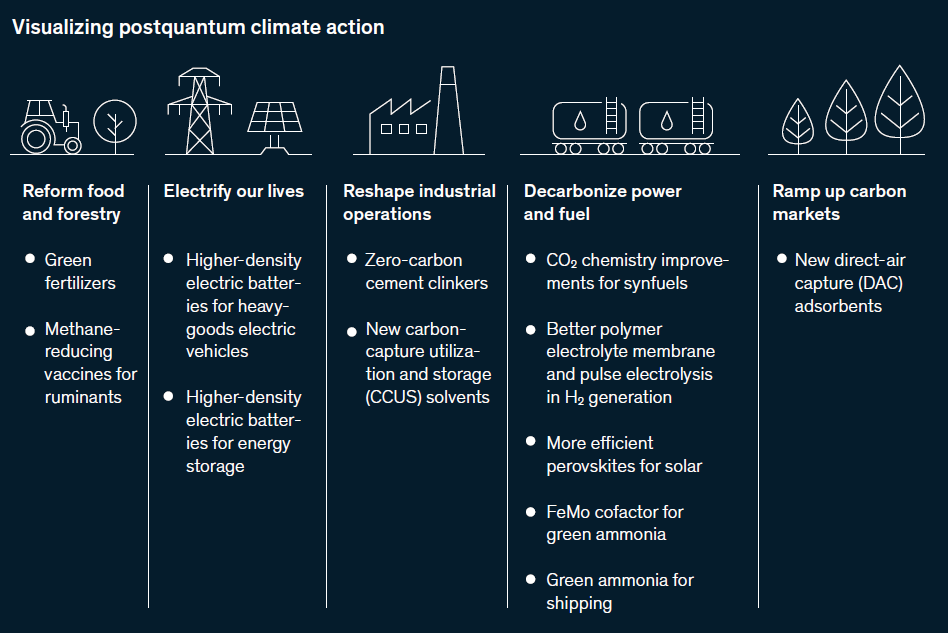
Examples include curbing methane produced by agriculture, producing carbon-free cement, improving electric vehicle batteries, developing better renewable solar technology, finding a faster way to lower the cost of hydrogen to make it a viable alternative to fossil fuels, and using green ammonia as fuel and fertilizer.
The article refers to the five areas established in McKinsey’s Climate Math Report as key to carbon release and identifies cases in which the use of quantum computing can pave the way to a net-zero economy. McKinsey estimates that by the year 2035, the use cases detailed in the article could allow the removal from the atmosphere of more than 7 gigatons of carbon dioxide equivalent (CO2e) per year, compared to the current trajectory.
For further reading, see the UN goals in the context of sustainability.