

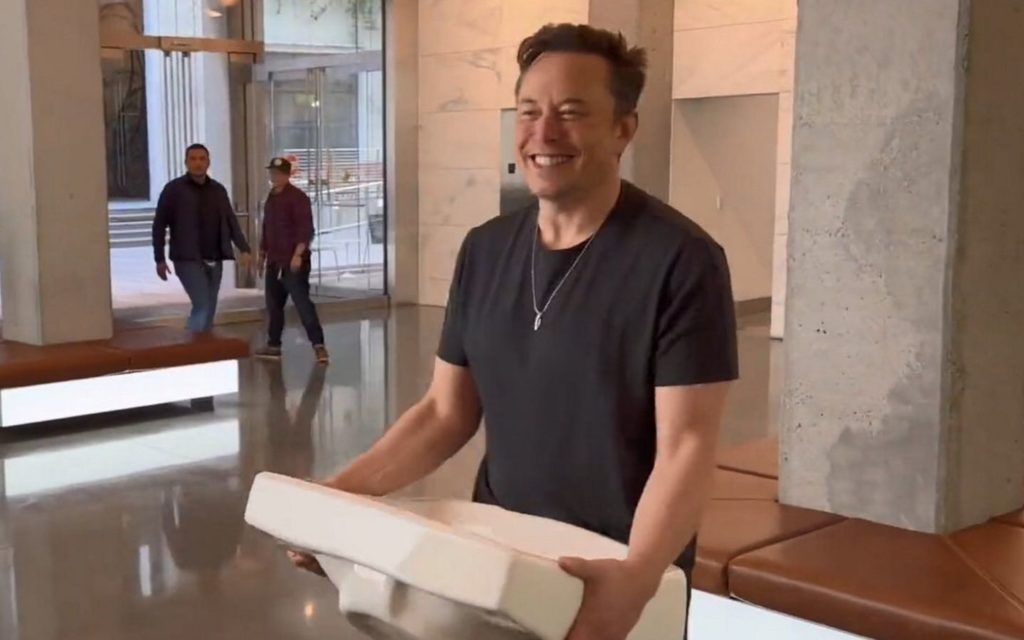
Two weeks after Elon Musk entered the Twitter HQ with a sink in his hands, his takeover of Twitter seems like a large-scale fiasco. Advertising revenues shrank, half of Twitter’s employees were laid off, and the worth of Musk’s other assets – including Tesla – keeps plummeting. How did it all come to this, and what early lessons can be learned from the apparent failure of one of the biggest digital leaders of our time?
- A disruptive visionary or yet another right-wing social-media pundit?
- A modern superhero or a villain?
- A leader that is doing the right thing at the right time?
Elon Musk’s track record over the years made him an undisputed digital leader and one of the richest men alive. Nevertheless, thus far, the story of his Twitter takeover may look more and more like a classic case of hubris. Two weeks after the acquisition of Twitter by Musk, the platform’s advertising revenue has plummeted and its income prospects, which weren’t great from the beginning, disappeared.
Half of Twitter’s 7500 employees, who only a week ago were urged to print their code out for “code pairing” sessions with Musk, were laid off last week as an immediate response to the dropping revenues, while the other half seems to have lost communication with the headquarters once the executive board was dissolved and the company is now managed personally by Musk and his close allies.
Musk and Twitter – The Background Story
As controversial as he may be, it is hard to ignore Elon Musk and his truly revolutionary innovations – from PayPal through Tesla, Neuralink, and The Boring Company, all the way to SpaceX. And much of their fame is owed to Musk’s ability to unstoppingly “tweet.”
Musk seems to be online 24/7, and his Twitter profile, @elonmusk, became notorious for his straightforward attitude, literal jokes, and airing the most controversial ideas – and then taking some of them back – while keeping a straight face throughout.
In light of these recent events, few remember that the apparent Twitter acquisition fiasco began at Musk’s attempt to protect “free speech” on the platform, especially after former US President Donald Trump was banned from it, together with other mostly conservative speakers, including the satirical outlet “Babylon Bee”. In January 2022, shortly after Trump’s ban, Musk became Twitter’s largest stock owner, holding 9.1 percent of its shares.
In April 2022, Musk offered – as usual, in a tweet – to acquire Twitter and restore freedom of speech, and if this was only a joke – it was understood very literally by Twitter’s then executive board, who viewed this as an attempt at a hostile takeover.
Eventually, after implementing a “poison pill” strategy first, the board accepted Musk’s offer to buy Twitter out for $44 billion and turn it into a private company. A lengthy 6-month ordeal followed, during which Musk tried to withdraw from the seemingly unfavorable deal by accusing Twitter and its executives of misleading and misrepresentation, while Twitter, in return, filed a lawsuit against Musk aiming to urge him to complete the deal before the official “drop dead” deadline in late October.
The $44 billion sum was enormous for a small – albeit influential – social network like Twitter. Contrary to Facebook, which positioned itself as a place for almost everyone, Twitter was a platform loved by activists and journalists, a round-the-clock press-conference where statements were made and political disputes took place on a daily basis. As such, it attracted a more focused audience and a much smaller piece of the online advertising cake.
In early 2022, Twitter projected that its annual operating cash flow would be less than $2 billion. By acquiring Twitter shares in January 2022, Musk personally caused the stock price to surge and set a high buyout price; by later trying to pull out of the deal and having Twitter drag him to court, he’d seen the stock diving before being urged to buy all Twitter shares at an inflated price of $54.2 per share.
The Immediate Consequences of the Twitter Takeover.
Not only the Twitter stock suffered greatly. To finance the costly acquisition, Musk had to sell $4 billion of Tesla stock, while using additional $62.5 billion as securities for a personal loan. As a result, Tesla’s stock price began to dive since the acquisition announcement, and on November 9, 2022, reached a two-year record low of $177.59 per share – 50% of its worth in the beginning of 2022. Moreover, due to the recent mass-scale layoffs, Musk had to pull dozens of software developers from Tesla to Twitter for an undisclosed period of time.
Musk’s rather radical understanding of “free speech” has also claimed its victims. Numerous advertising agencies pulled their budgets out of Twitter, fearing for brand safety on a platform that may soon be full of potential misinformation and hate speech. And even before brand safety was considered, automotive companies were among the first advertisers to pull out of Twitter following Musk’s takeover, out of fear that their customer databases used for advertising would end up in the hands of Tesla marketers.
While still being supported by a close group of conservative allies like Peter Thiel and Larry Ellison (Oracle), who also provided him financing for the Twitter deal, Musk seems to have – at this point in time – lost the trust of a large part of Twitter’s audience and opinion-makers, who made the platform what it is today.
Lastly, he also seems to have lost touch with the employees still left at Twitter. While his entry to the Twitter HQ with a sink in his hands (“Let that sink in!”, yet another literal joke…) could have been considered humorous, what happened later was far from it. Software developers were made to print out their recent code, then shred it; long night shifts followed with employees sleeping on the office floors; and finally, the mass layoff of half the company’s staff, executives included, and dissolution of the board by Musk, who now crowned himself “Chief Twit”.
In the first two weeks following the takeover, Twitter employees received scarce news about their fates only from Musk’s Twitter profile. Those of them who survived until November 10, were finally treated to the first communication from Musk, where he announced radical changes – instead of an unlimited work-from-home policy, Twitter employees will now be expected to work from the office at least 40 hours a week. This, in turn, would probably cause more employees to abandon the Twitter ship.
Our Analysis and Lessons Learned.
While it is too early to prophesize the fate of Twitter, there are some lessons to be learned by digital leaders even at this early stage. First, even very stable geniuses may often exhibit poor judgment and fail, and often the failure would be noticed too late to be remedied. Musk, a very literal and straightforward individual, to say the least, could not have withdrawn from his statement about purchasing Twitter; and when he finally wanted to withdraw, it was already too late. In a world where news travels fast, one should be very careful about the statements they make on social media, as they would be taken seriously – as ridiculous as they may be.
The second, and most important lesson of all, is that the apparent Twitter fiasco is yet another example of cultural eating strategy for breakfast. While Musk is, without a doubt, a brilliant businessman and innovator, his worldview seems to be very different from the majority of Twitter’s stakeholders – its users: activists, politicians, journalists, Hollywood actors, and other opinion makers; its advertisers; and its employees.
Now, it seems that while the employees and users are jumping ship, indifferent to the introduction of $8 “verified” profiles, the advertisers are waging a real war on Twitter, a war of attrition that might lead to the platform’s decline and Musk’s loss of his “richest man in the world” position.