


Pursuing a winning design with AI. See how the McKinsey engineers, designers, and the sailors of Emirates Team New Zealand used AI to create ideal hydrofoils.
The America’s Cup, the oldest trophy in international sport, is competitive sailing’s most coveted prize. When the 36th edition began in early March 2022, the race’s defending champion, Emirates Team New Zealand, hit the water having utilized a new crewmember: an AI bot created by McKinsey. It turned out to be a winning combination.
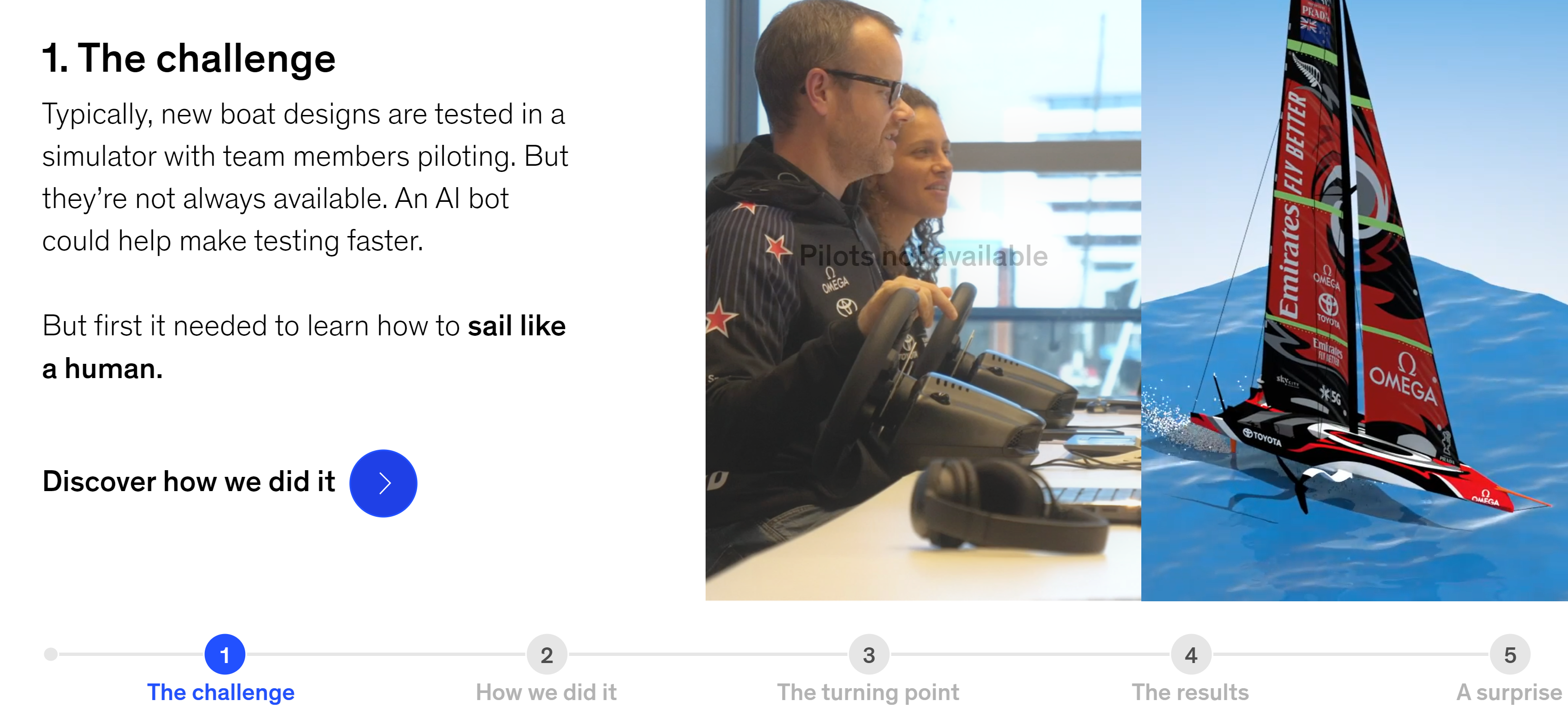
“Every boat in the America’s Cup is designed with a computer simulator,” says Brian, who sails competitively. “Whichever team has the best simulator, and uses it most effectively, gains the advantage.”
In 2019, Emirates Team New Zealand partnered with McKinsey to begin an innovative project seeking that advantage. What they needed, they soon realized, was a new kind of crew member that could sail thousands of boats at a time. The answer to that call was an AI bot, or software robot, that could test new hydrofoil designs by sailing them on Emirates Team New Zealand’s simulator.
“Our goal,” explains McKinsey senior partner Brian Fox, “was to speed up testing of Emirates Team New Zealand’s designs. By developing an AI bot that could run the simulator by itself, we no longer had to manage around the sailors’ limited availability.”
As a first step, the McKinsey team, which included colleagues from their analytics firm QuantumBlack, turned to the cloud. Over six-weeks, data, analytics, and machine-learning experts migrated New Zealand’s simulator and developed an infrastructure to run it in the cloud.
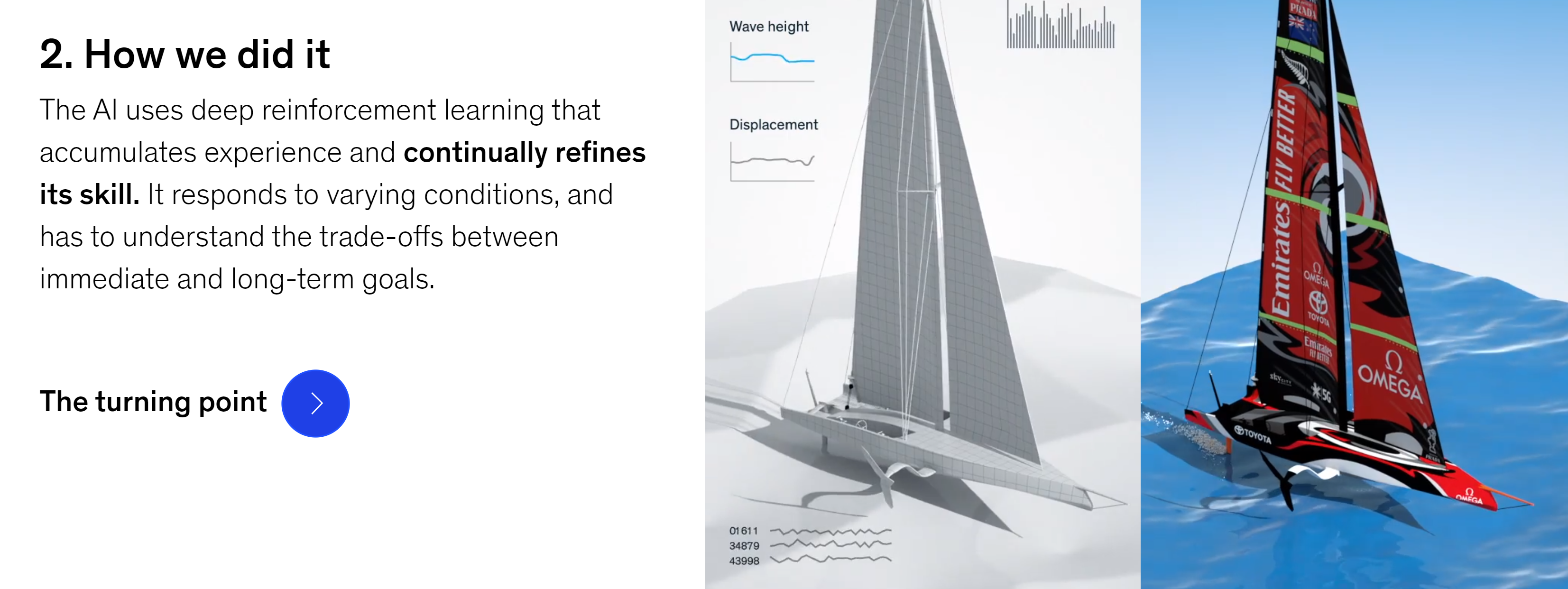
Then McKinsey’s team used a new and innovative approach called deep reinforcement learning to essentially teach the AI bot how to become a professional sailor. The technique allowed the bot to learn dynamically and gain greater accuracy through continuous feedback.
At the start, the AI agent knows nothing and learns by trial and error using countless variables—wind speed, direction, adjustments to the 14 different sail and boat controls—and is refined again and again Since the bot keeps experimenting, if you coach it to learn in the right way, it compresses into hours what would take a human years to understand.
The work was highly technical and it required extensive innovation around the bot’s learning program. At this point in the project, a lot of creative thinking had to be done to figure out the right learning models, how best to coach the bot, and the right guard rails and rewards to put into place.
The team also created a network that allowed multiple bots to share information as they each learned to sail. This was a critical breakthrough, as it allowed the individual bots to gain knowledge from their collective experience. Ultimately, there were a thousand bots running in parallel, learning from each other.
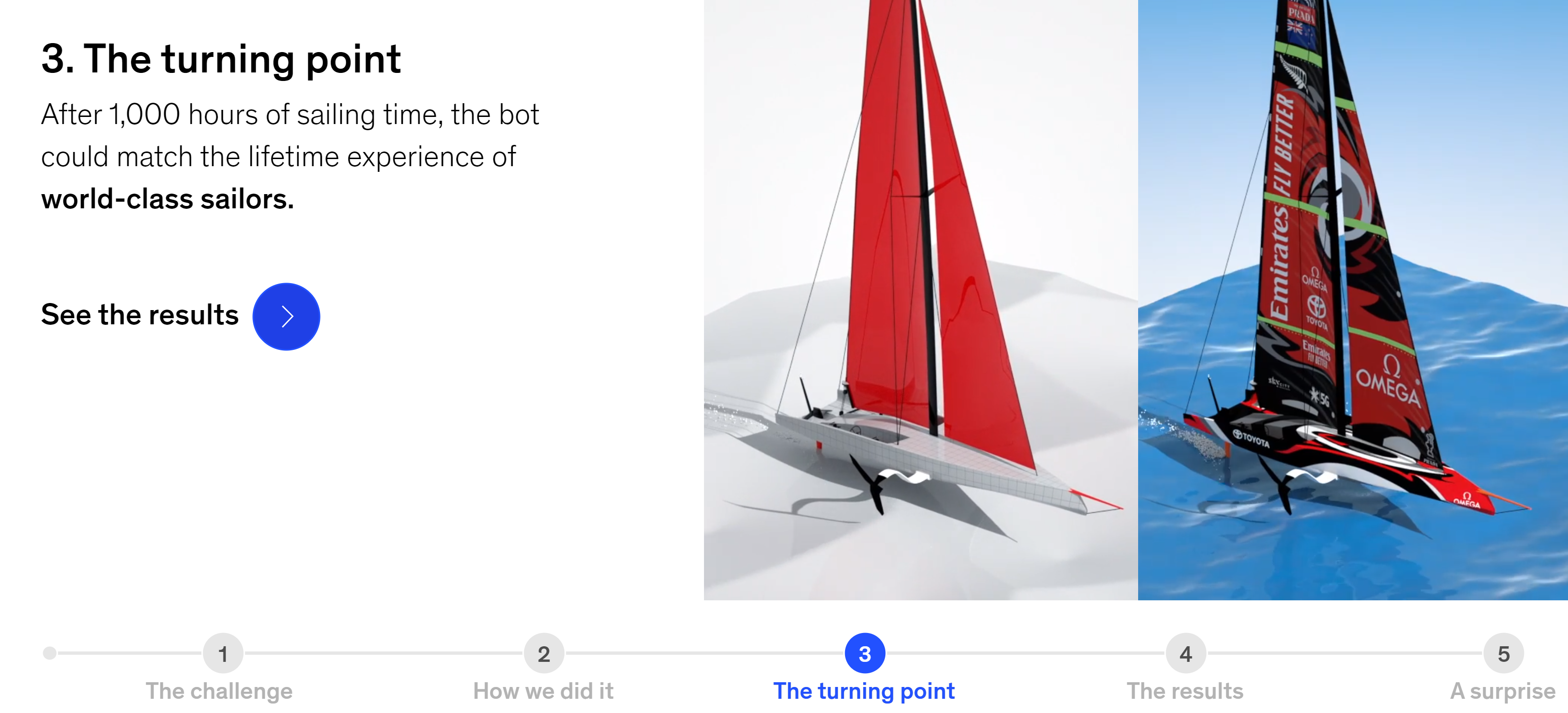
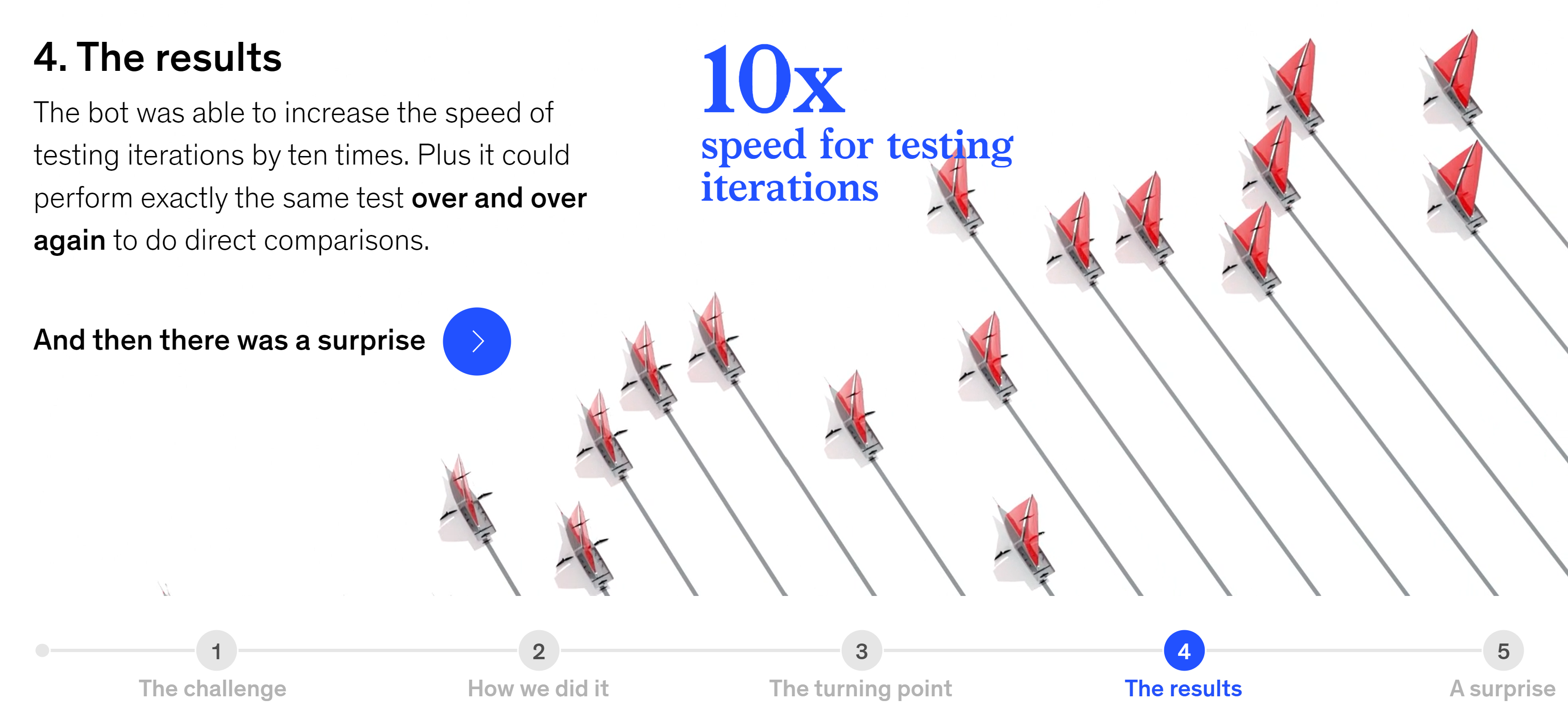
The turning point came about eight weeks later, when the AI bot started beating the sailors in the simulator. At this point, the bot became the ideal way to test variations of the hydrofoils; it was more consistent and more scalable than the sailors, speeding the cycles of design iterations dramatically. “This was the critical unlock—the ability to take the sailors’ schedules out of the equation and test designs 24/7 on rapid repeat,” observes Helen Mayhew, a McKinsey partner and member of the QuantumBlack leadership team in Europe, who is also a world champion sailor.
The race’s outcome proves that reinforcement learning can be a transformational tool for process design, with potential applications across industries.