
One equation to rule digital transformation.
During the last 6 years Digital Transformation has become globally the most relevant, talked about and implemented strategy.
I’ve been working with government entities, defense organizations, private sector companies and higher education institutions on helping them build their digital transformation strategy.
Also, I have taught for three years a course on digital transformation for executives, in the aim to provide them practical and business understanding.
Even though it is one of the most hyped and used terms and concepts, it is still mostly misunderstood (as I see it).
The vast majority focus on the “digital” part of the term, with the perception that the new and advanced technologies can drive a huge change for and in organizations and their customers.
But, the focus is, and should be, entirely on the “transformation” part. And then, and only then, how the “digital” part can enable and drive it.
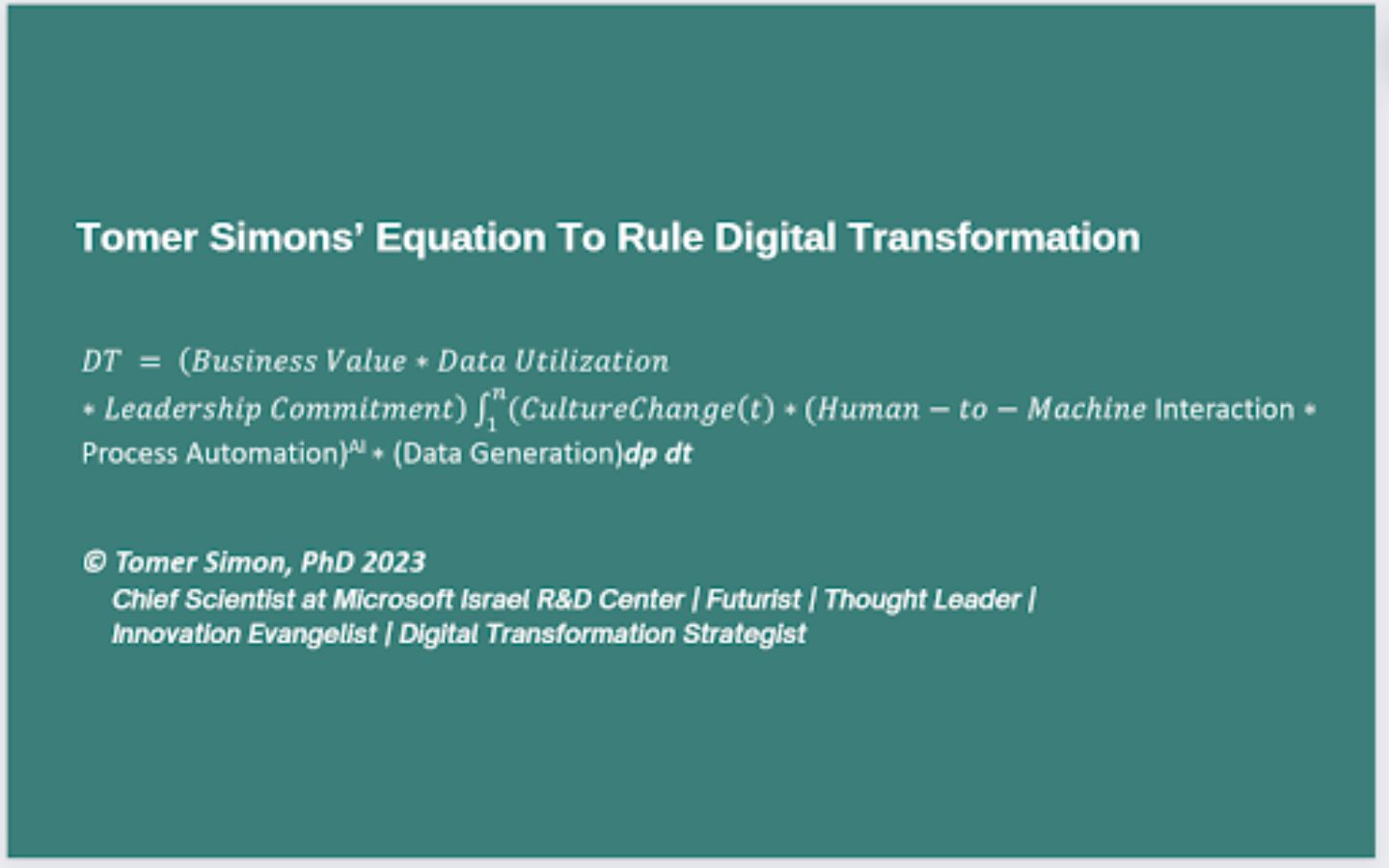
I created a business equation for digital transformation as a conceptual model, to try and convey the multi-dimensional nature of digital transformation and the interplay of its different factors.
The integral (∫) signifies the continuous, large-scale nature of the transformation, and this is the most fundamental piece to understand.
The integral (∫) is evaluated from 0 to n, where n represents the total number of business processes in the organization. This is why the integral is evaluated over “dp” at the end (the transformation of the business processes is the essence).
Culture Change(t) is a function of time (t), emphasizing that culture change is an ongoing process that evolves over time.
(Human-to-Machine Interaction * Process Automation) represents the transformation of human-managed processes into machine-managed ones, which is amplified by the power of AI.
Data Generation is included within the integral, reflecting the ongoing generation of new data throughout the digital transformation process.
Outside the integral are all the components that without them the digital transformation will not succeed.
Leadership Commitment conveys that without leadership commitment (i.e., if leadership commitment is zero), the transformation effort would not succeed.
Business Value and Data Utilization are two additional multipliers outside the integral, reflecting their critical roles in driving the outcomes of the digital transformation process.
Digital transformation is not a one-time event but an ongoing process that occurs over time, and this is why the dt at the end that serves a dual purpose, indicating the variable of time and, symbolically, the concept of Digital Transformation (DT).
You also add IoT and Cloud next to AI to signify how the technology can amplify and enable and accelerate the transformation. But the technologies are not driving it.
Happy to hear your thoughts and feedback – link below.